Two robot dogs. One burning house. No map.
Search through smoke.
Inspect every decision.
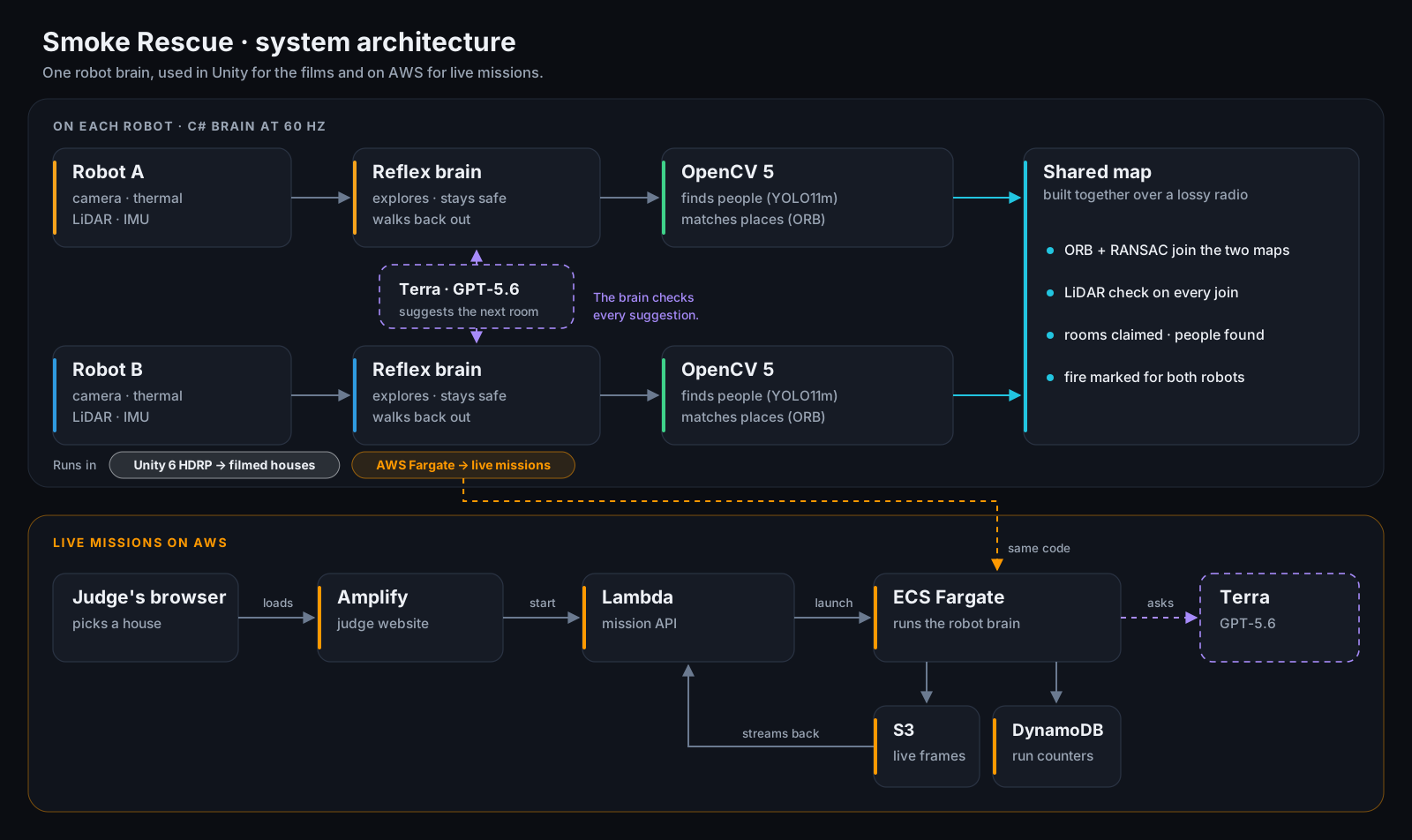
Smoke Rescue sends two quadruped robots into a burning house they have never seen. Each robot runs the same onboard brain: it explores room by room, finds people with OpenCV 5 colour and thermal detection, and builds a map it shares with its partner over a lossy radio. OpenCV 5 ORB place recognition corrects the shared map when one robot sees a place the other already mapped. Terra, a GPT-5.6 agent, reads each robot's report a few times per mission and suggests the next room to search; the brain checks every suggestion and keeps moving while Terra thinks. When the search is done, both robots walk out along their own trail.
Measured results
What the robots did
| Filmed house (Unity) | People found | False finds | Both robots out | Mission time |
|---|---|---|---|---|
| Three-bed ranch | 5 of 5 | 0 | Yes, at 365 s and 375 s | 6:16 |
| L-shaped ranch | 4 of 5 | 0 | Yes, at 369 s and 413 s | 6:53 |
| One-door house | 4 of 5 | 0 | Yes, along their own trail, at 454 s and 463 s | 7:44 |
On 39 real floor plans the brain had never seen (HouseExpo, headless simulator, 25 October 2026), two robots sharing one map found 99% of people and one robot found 92% (p = 0.002). Map merging measured robot B's start tilt as 2.42 degrees against a true 2.39 degrees, with no duplicated people.
01 / Recorded evidence
Watch an agent test run
Loading the run catalog.
Walkthroughs show recorded robot views and decisions. Use fullscreen to inspect the camera panels. Simulation timestamps in the trace may differ from video playback time. The trace below provides searchable decision text.
02 / Evidence to action
Follow the agent's decisions
Each step groups the triggering event, executed tools and resulting orders. A missing verdict means the log did not record one. Model summaries are claims by the model; check the tool errors and evidence IDs.
Choose a run to load decisions.
03 / Offline evaluation
With and without agents
Choose a run to load metrics.
Values come from brain.compare_runs. Agent counters come from the run summary and can differ from the executed calls in the trace. Search area is a coverage proxy within 2.5 m of the true paths, sampled on a 0.5 m grid. It is not verified visible floor area. A survivor match uses a 1.5 m threshold. Compare duration and scenario before drawing conclusions; a short test does not establish a rescue benefit.